Showing posts with label connect. Show all posts

Wednesday, 1 November 2017

Interdisciplinary Connections

Whakatauki:
Koinei nga whitiki whakairo e kaha ana.
It is the braided threads that are the strongest.


Current Collaborations

Chief Seattle said, “Man does not weave this web of life. He is merely a strand of it.  Whatever he does to the web, he does to himself.” I think that this is true of professional collaboration. We enrich ourselves when we interact and collaborate with others. The eyes of many on a shared topic or working together to support a colleagues, student or whanau holds great potential, promise and impact.


Through the Kāhui Ako I have seen powerful examples interdisciplinary collaboration. Secondary school teachers working interdepartmentally on common goals such as raising literacy, or with primary school teachers on transition and shared skill sets such as differentiated education. Group Special Education supporting teachers through a deeper understanding of behaviour management, narrative assessment,  and alternative approaches to learning is another example of interdisciplinary collaboration. These represent Andrews’ definition of interdisciplinary collaboration “when different professionals, possessing unique knowledge, skills, organisational perspectives, and personal attributes, engage in coordinated problem solving for a common purpose” (cited in Berg-Weger & Schneider, 1998). The common purpose being the progress of individuals and cohorts of students within our classrooms, or the development of skills within ourselves and our colleagues to benefit those students.
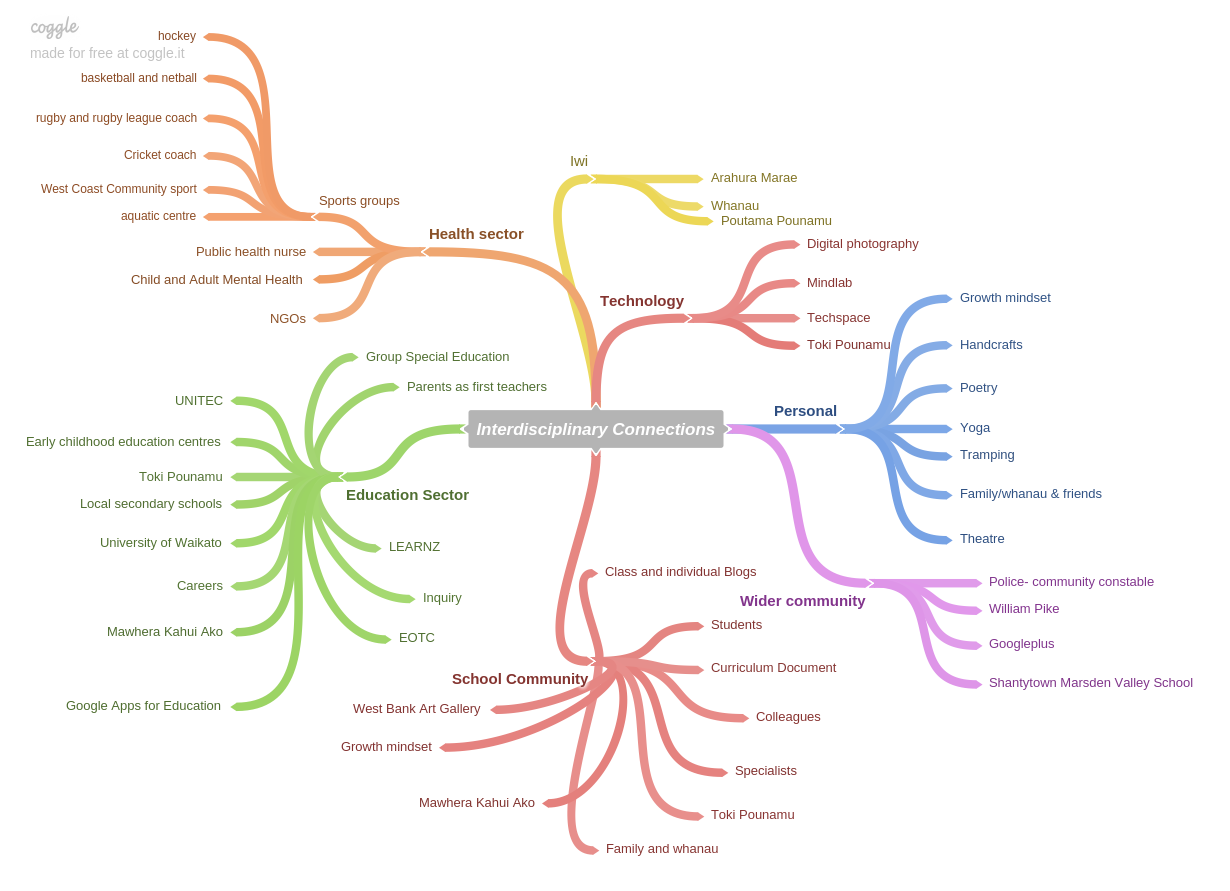


Focus Interdisciplinary Connection

Increased whanau engagement in student education will require an interdisciplinary connection. The empowerment of whanau, recognition of their cultural histories and rich layers of skill, experience and connection that they share with their children, must be a component of the developing relationship between them, the classroom teacher and the student. Developing the shared goals for the student, wrapping that student around with common language and shared attitudes and values, and supporting both the school and the whanau to meet shared goals is an ideal worth investing in.


A first step might be to enter into a reciprocal conversation with student and whanau and, working from a position of strength,  identify what the student already brings to their learning relationship, and what the whanau can bring to support that learning relationship. The next steps might be to identify the goals each contributor might have for the student.  


As in any action plan identifying the support structures and resources that are currently available or may need to be accessed for family would be a required step. This could also open up an awareness for whanau of the strengths that they already possess in relation to the growth of their child within the concept of hauora, a rich and all encompassing approach within Mātauranga Māori and applicable and enriching for all students.


Relationship: collaboration, connection and conversation deeply rooted within a rich understanding of the culture of each child and their whanau is the way forward for increasing whanau engagement in student education. Ako between whanau, school, and student, acknowledging that each party and their support systems has value and can contribute to the educational outcomes as a reciprocal relationship, this is the key to richer whanau engagement in student education,


Friday, 20 October 2017

Social Media Use In Teaching and Professional Development

P1020246.JPG
Whakatauki:
Ko te hono atu ki etahi atu e hono ana ia tatou ki a tatou ano
Connecting to others connects us to ourselves.


Social Media In Teaching
I grew up when the introduction of a class intercom was a big deal. To teach in a world where individual students could be connected online, through the very ether (or ether net) that surrounds us was an elaboration of science fiction. And now science fiction increasingly becomes passe, science fact.  
Social Media In My Classroom
As Cassidy reiterates, our students are already familiar with digital affordances, therefore it is implicit that this would be a core element of their educational experience.  Social media holds an increasing presence in my classroom and is a conduit for collaboration and connectivity between teachers,  students and whanau.  We share our learning with an authentic audience beyond the boundaries of the physical classroom. Students participate in online learning networks, providing and receiving thoughtful, positive and helpful feedback to and from their peers. In line with current pedagogy such as that espoused in Innovating Pedagogy 2016: Open University Innovation report 5  we have also used social media to access experts including artists, conservationists, and historians to introduce validity and authenticity to our learning programmes.
Challenges and Considerations
Social media sites such as youtube and vimeo provide a wealth of information and inspiration for students however there has been a lot of teaching in behind the access and use of these resources. When we initially set up our access to online sites our school was advised to limit student access to online sites.  Our response was to negate that suggestion in favour of engaging with students in discussion about responsible use and cybersmart choices. This allowed students to retain their access to a rich resource. This has been overwhelmingly positive with only a small number of students choosing to misuse this right.  We have then worked with that small group, removing privileges of open access, giving further education, and then slowly reintroducing the responsibility of open access.
Benefits
Having access to experts and exemplars through an online and immediate forum has engaged students at a  deeper and more individualised level. Students have used social media to support and collaborate with each other, to engage with their extended whanau, to teach others and to learn from their peers.
For staff there has been an increased online access to social media and social networks specific to their profession. This has provided opportunity for individualised skill building, deeper content and practice knowledge, and an enhanced sense of connectedness and collegiality. The new Code of Professional responsibility and Standards For The teaching Profession can be seen to promote the adoption of social media through the ‘design for learning’ and ‘learning focused culture’ standards in particular.
Concerns
Our greatest concerns around student misuse of social media have arisen through irresponsible or unsupervised use in the home. Parents have often looked to the school to resolve online issues that have arisen through sites such as ‘Kik’, ‘Snapchat’, ‘Google Hangouts’, ‘Youtube’,manifold chat rooms available through online game sites … It is staggering at times how little parents are aware of what sites their children are connected to, who they are connected to through those sites, and the legalities of those connections.  
Parent education has been an aspect of our digital classroom development. We still struggle to engage all whanau in parent sessions however perhaps we are misinterpreting the need.  We may be trying to  impose on them in an area that they do not actually feel they need help or support. The online issues that arise for their children within their home may be seen as either the responsibility of the school or not seen as important at all. This can sometimes mean that when a line is crossed parents and whanau may not seek support because they feel a sense of failure to have ‘allowed’ a situation to escalate. Situations, as we know in the classroom only too well, don’t always ‘escalate’, sometimes they just implode or transpire.
Steps Ahead
To date the use of social media within my classroom and my kura has been surrounded by safeguards; discussion, limited filtering, staff and student knowledge and skill development. We have been open and aware of the possibilities, both pitfalls and positives, because this is a time of exploration for us. Maintaining an awareness and an alertness, maximising opportunities for teaching and learning through social media, maintaining a culturally responsive perspective, and keeping pace with the changing social media forums will be future challenges for us.